Makiko KOIE
Born in Kyoto.
Graduated from Kyoto City University of Arts.
Lives in Nara
http://www.makikokoie.com
< Selected Solo Exhibitions >
2010 Zeit-Foto Salon, Tokyo
2009 Ohara Museum of Art, Kurashiki
2003 Zeit-Foto Salon, Tokyo
2000 Zeit-Foto Salon ,Tokyo
1999 Gallery Nikko, Tokyo
1997 Gallery Q, GalleryQs, Tokyo
1996 Gallery Gen ,Tokyo
1994 Gallery Gen, Tokyo
< Selected Group Exhibitions >
2014 「Mada Mada Sugoizo! Ohara Museum」Ohara Museum /Kurashiki
2010 「Ohara-Contemporary」Ohara Museum /Kurashiki
2013 「Your Voice is Mine」NUS MUSEUM/Singapore
2010 「Ohara-Contemporary」Ohara Museum /Kurashiki
2010 「Ohara-best Exhibition celebrate 80th anniversary of Ohara Museum of Art」
2010 Ohara Museum /Kurashiki
2010 「Summit of the six@vanguard gallery」Vanguard Gallery/Shanhai
2009 "Japan meets China-Out Future reflected in Contemporary Art",Tochigi
2009 Prefectural Museum of Fine Arts,Tochigi
2009 "Art in Busan 2009 : Inter-City",Busan Museum of Art,Busan
2009 "A new store work of art exhibition",Ohara Museum of Art,Okayama
2007 "Collections II", 21st Century Museum of Contemporary Art, Kanazawa
2007 "Japan Caught by Camera", Shanghai Art Museum, Shanghai
2006 "Impact", Ohara Museum of Art, Okayama
2005 "Guangzhou Photo Biennial", Guangdong Museum of Art,
Guangdong
2005 "VOCA 2005", The Ueno Royal Museum, Tokyo
2005 "The Photography beyond 20 years from Tsukuba Museum of Photography
2009 1985",
Sendai Mediatheque, Sendai
2005 "The Art of Breathing in the World: Art and Respiration ", Kawamura Memorial
2009 Museum of Art, Chiba
2005 "Seoul International Print, Photo & Edition Works Art Fair", Hangaram
Art
2009 Museum of Seoul Arts Center, Seoul
2004 "Mask of Japan Contemporary Japanese Photography", Guangdong Museum
2004 of Art, Guangdong
2004 "Modern Masters Collection", 21st Century Museum of Contemporary
Art,
2004 Kanazawa
2003 "Genomic Issue ( s ): Art and Science", The Graduate Center
of the City
2003 University of NewYork, NewYork
2003 "NiCAF '2003", Tokyo International Forum Exhibition Hall, Tokyo
2003 "City_net Asia 2003", Seoul Museum of Art, Seoul
2003 "Mask of Japan", Aura Gallery, Shanghai
2002 "Kiss in the Dark", Marugame Genichiro-Inokuma Museum of Contemporary
2002 Art, Kagawa
2002 "Art and Medicine", NTT Inter Communication Center, Tokyo
2002 "photoGENEsis: Opus 2", Santa Barbara Museum of Art, California
2001 "VOCA 2001", The Ueno Royal Museum, Tokyo
2001 "NiCAF '2001", Tokyo International Forum Exhibition Hall, Tokyo
2001 "OFF TRIENNALE", Ryunichi kantonkaikan, Yokohama
2001 "Kiss in the Dark", Tokyo Metropolitan Museum of Photography, Tokyo
2000 "Contemporary Photograpers of Japan", Shanghai Sanya Photograph
Gallery,
2000 Shanghai
1998 "Philip Morris Art Award 1998 'Final Selection '" , Tokyo International
Forum
1998 Exhibition Hall, Tokyo
1997 "The 26th Contemporary Art Exhibition of Japan", Tokyo Metropolitan
Art
1997 Museum, Tokyo
/ Kyoto Municipal Museum of Art, Kyoto 〔' 98, ' 99 〕
1994 "EX+", Chiba Prefectural Museum of Art, Chiba
< Public Collections >
Tokyo Metropolitan Museum of Photography, Tokyo
21 st Century Museum of Contemporary Art, Kanazawa
Ohara Museum of Art, Okayama
Guangdong Museum of Art, Guangdong
Shanghai Art Museum, Shanghai
NUS MUSEUM, Singapore
< Publications >
2010 [Aura] Seigen-sya
< Awards >
2005
The Most Promising Young Talent Prize in Fine Arts of Kyoto City
Ohara Museum of Art Prize at VOCA 2005, The Ueno Royal Museum
"Feverish Space of Tranquility"
MOTOAKI HORI (Curator at the Museum of Modern Art, Kamakura)
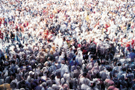
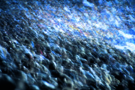
Tens of thousands of complete strangers gather at horsing racetracks and baseball stadiums. There is a peculiar atmosphere to the din and bustle created in these places.
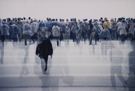
Each word has a meaning for the people that are talking to each other, but the reverberations of sounds that have completely harmonized is similar to an unknown language. But at the same time, there is an odd communication among the spectators, as they all have the common interest of following the course of the event and finding out the results. At a racetrack, there are as many expectations, desires and dreams that are intermingled as the number of betting tickets that are sold, yet the center of attention of all the spectators is the same. Deafening cheers are raised, and after the cheers abruptly fade away into the distance, then comes the strange silence. Then, once again, comes a roar of joy and a disappointment that cannot to be put into words. Sharing the same place, time and purpose can generate the kind of excitement that enables us to confirm that we are alive. Makiko Koie clicks the shutter of her cameara to capture people's resonating reactions that reflect their unseeable feelings.
Needless to say, the medium of photograph does not simply capture objects as they are, but aim to signify something beyond the objects. For instance, Jeff Wall's works imply issues related to race, politics, society and sex through scrupulously calculating his compositions and models. Beat Streuli and Philip-Lorca diCorcia both utilize the framework of a documentary photograph, and show glimpses of the various phases of life of people today. Andreas Gursky's works such as Autosalon, Paris, 1993, Chicago, Board of Trade, 1997, and May Day, 1998 are comparatively close to Koie's images of the crowds of people at racetracks and stadiums.
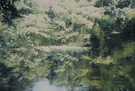
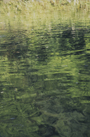
However, unlike the fashionable nonchalance found in Gursky's photographs, Koie's works, which slightly shift and overlap print and film images, contain a feeling of a continuous, slight "fever." The feeling applies not only to the works taken of crowds, but also to the photo taken of green leaves that are spread across an entire surface. In this work, instead of the din and bustle of people, the whispers of the leaves, as if they are whispering to each other, convey the lives of nature. But then, all of her works give the impresshion that they are dominated by complete silence. The act of visualizing an invisible world, by contrast, erases every sounds. Her works that aim to jolt the existence of the visual world to its foundation might have some similarities with psychic photography. Koie is no doubt pursuing "the something" that is paradoxical, essential and transcendental through the techniques of stratifying and creating vague images. It is also a fact that the other world she aims to create to symbolize "the something" which could also be called spiritual, could truly save today's world beyond marely escaping realities, because this is a special privilege bestowed upon only to works of art.
|